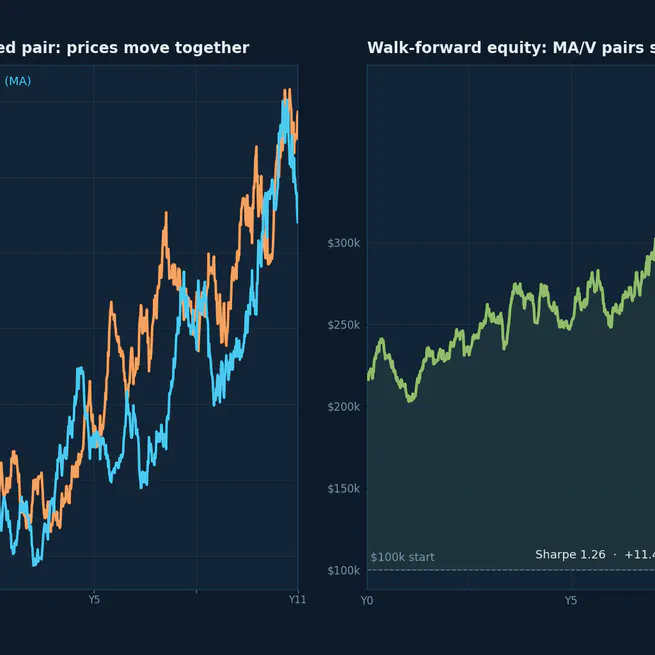
Statistical Arbitrage via Cointegration-Based Pairs Trading
A rigorous pairs-trading pipeline that asks whether cointegration-based statistical arbitrage survives out-of-sample testing once costs and selection bias are accounted for. Pairs are screened with Engle-Granger cointegration tests under Benjamini-Hochberg false-discovery-rate correction, traded on spread z-score mean-reversion signals using both static and Kalman-filter dynamic hedge ratios, and evaluated with walk-forward backtesting, bootstrap confidence intervals, Probabilistic and Deflated Sharpe Ratios.
Jul 1, 2025
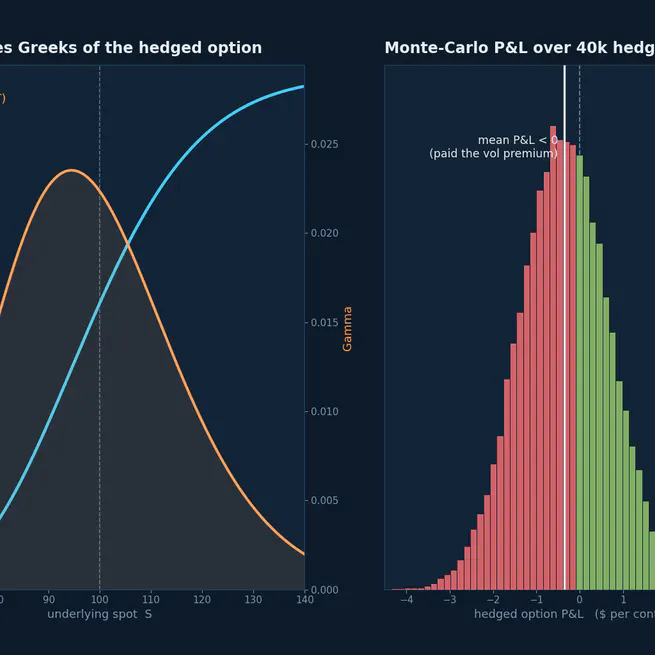
Dynamic Hedging of Options, Realized vs. Implied Volatility
A quantitative framework that treats a delta-hedged option as a bet on realized versus implied volatility, where a perfectly hedged long option’s P&L reduces to the gamma-weighted variance identity ½ Σ Γ S² (realized − implied). The project pairs a Black-Scholes-Merton pricing and Greeks engine (with a Newton-Raphson implied-vol solver) with a Monte-Carlo hedging lab that simulates thousands of GBM paths, validates the variance decomposition path-by-path, recovers the √Δt discrete-hedging error scaling law, and optimizes rebalancing against transaction costs. A real SPY call option trade is analyzed minute-by-minute, and an interactive Streamlit dashboard ties the modules together.
Jun 1, 2025
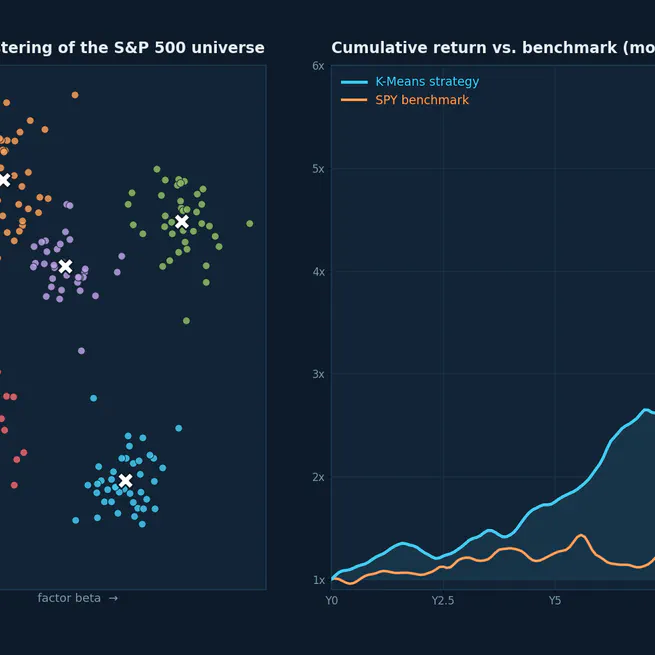
S&P 500 Portfolio Optimization via K-Means Clustering
A systematic, data-driven trading strategy that applies unsupervised machine learning to a decade of S&P 500 equities. Technical indicators (RSI, ATR, MACD, Bollinger Bands, Garman-Klass volatility) and rolling Fama-French 5-factor betas are engineered as features, then K-Means clustering with customized centroid initialization groups stocks each month. Portfolios are built from the selected cluster via maximum Sharpe ratio optimization, and cumulative returns are backtested against the SPY benchmark.
Mar 1, 2025

TinyStories LLM, Building a Small Language Model from Scratch
From tokenizer to transformer — a hands-on exploration of how large language models learn, implemented and trained entirely from scratch on TinyStories using PyTorch.
Oct 1, 2024

Simulation Study of the Metropolis-Hastings Algorithm for Distribution Sampling
A simulation-based study of the Metropolis-Hastings algorithm using Python. This project explores MCMC sampling from t-distributions and normal distributions with both unconditional and conditional proposals. Includes visual analysis using histograms and QQ plots. Developed as part of a graduate-level course in statistical inference. Highly relevant for Bayesian inference, probabilistic modeling, and ML research.
May 1, 2024

Gaussian Process Regression for Robotic Arm Modeling
This project explores the use of Gaussian Process Regression (GPR) to model the kinematics of a robotic arm with eight input parameters (joint angles and link lengths) and a nonlinear output (tip distance from origin). Various kernel functions are evaluated, with performance analyzed via uncertainty plots and mean squared error (MSE) metrics.
Oct 26, 2023

Solar Flare Detection via GLR-Based Change-Point Analysis
This project detects solar flare events in NASA’s solar observation video using a statistical framework based on the Generalized Likelihood Ratio (GLR) test. Principal Component Analysis (PCA) is employed to enhance the Gaussianity of the video data, improving the performance and reliability of the GLR-based change-point detection. The approach offers a lightweight, unsupervised change-point detection algorithm.
Oct 1, 2019